Listen, Color, Write: Low-Prep Reading Game for World Language Classes
Work Smarter, Not Harder: Extend a Story for Maximum Impact in Your Language Class
Want to make your lessons more engaging while lightening your prep load? Try stretching a single story over multiple days! By reusing a captivating text, you’re able to dive deeper without extra prep—and students continue building language skills with increasing confidence. It’s a win-win!
Recently, I shared a story with my 7th graders about my dog, Max. The story reinforced vocabulary for days of the week and telling time. Not only did my students enjoy it, but I also got to “bring Max to class” every day, making it feel personal.
Then, one morning, I had a lightbulb moment: I could keep using this simple story by making it a re-reading game! Here’s how it went:
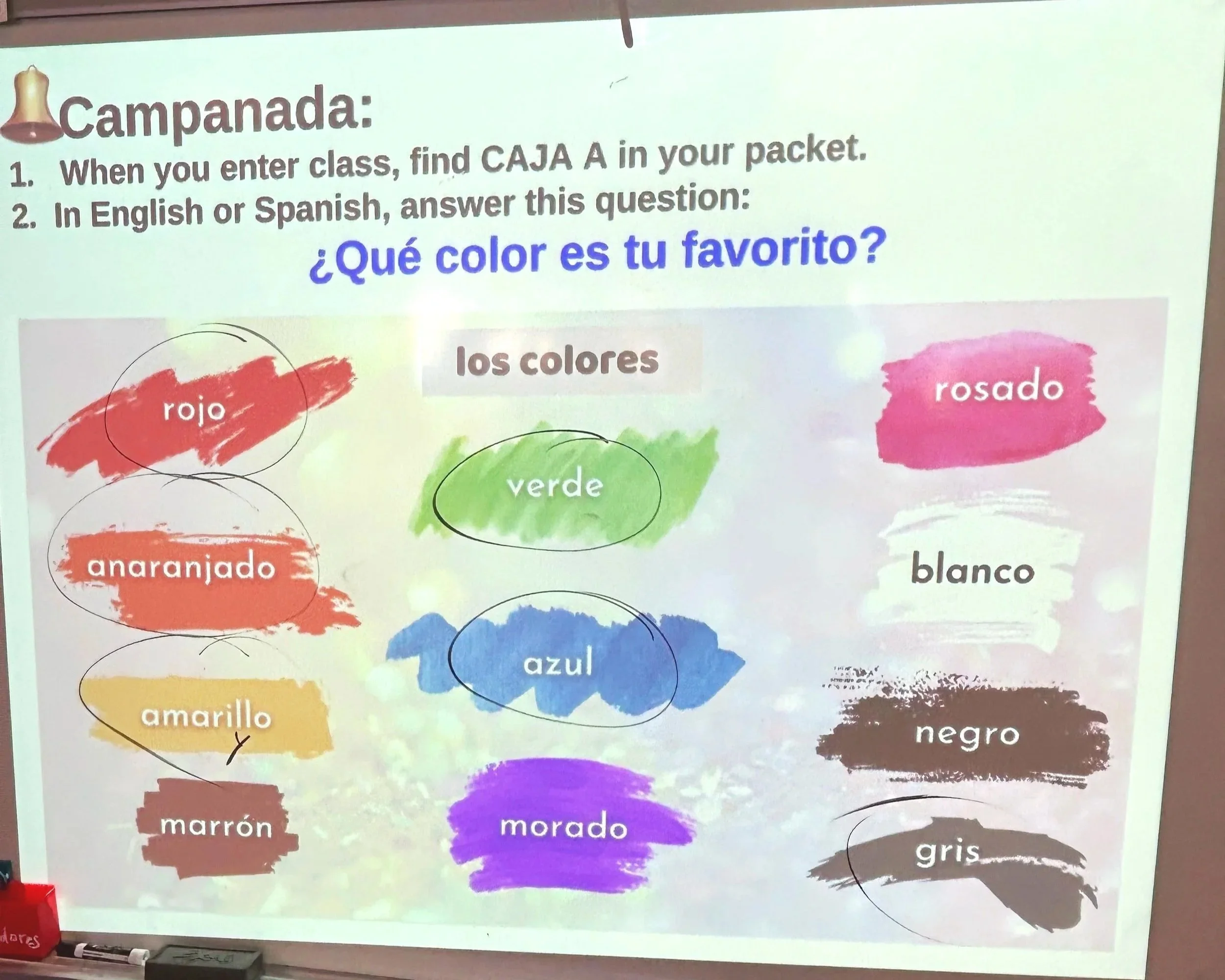
Project a color word slide and circle the colored pencil options you’re using for the game.
Game Setup:
I created a 3x4 grid, numbering each box 1-12. In each square, I added a snippet of the story—one version in Spanish and a duplicate grid in English. Each grid was printed on different-colored paper for easy distinction.
Then I gathered colored pencils in six colors: red, blue, orange, yellow, green, and gray.
Step-by-Step Guide
Distribute Colored Pencils: Give each student one pencil in a different color. (Tip: Assigning classroom jobs makes this part go smoothly!)
Hand Out English Grids: Each student receives a copy of the 3x4 English grid. Each numbered box on the grid contained text from the story.
Project a Color Vocab Slide: This visual helps students follow along with color instructions.
How to Play
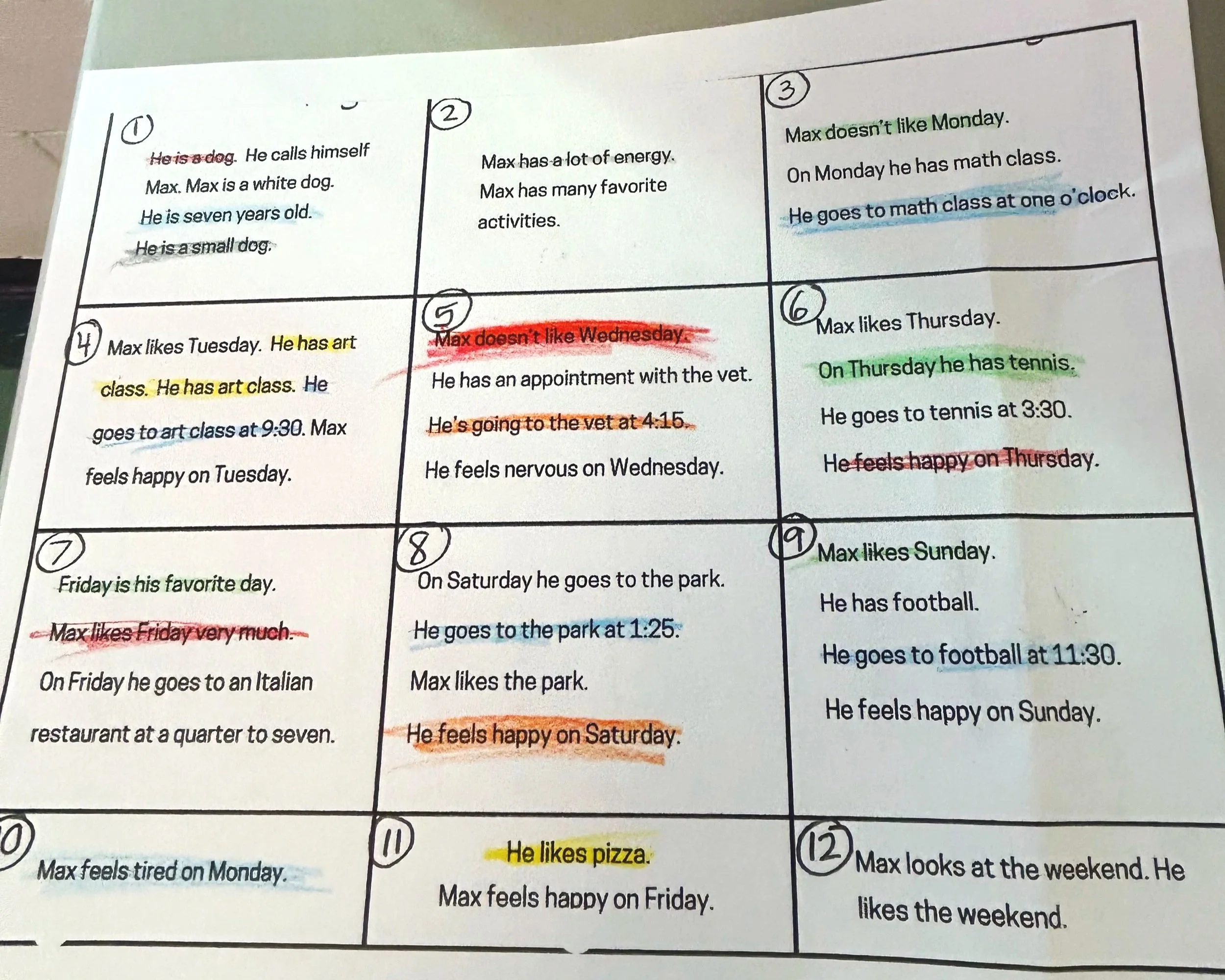
English Grid for round one Listen/Color. Two different colors per box works best!
Round One: Listen, Color
While students are scanning the English grid, read a Spanish sentence from a box aloud in Spanish.
Then call out a color. Students would then search for the English translation and lightly color over it in the specified color.
Example:
If I said, “Max is a white dog: VERDE” students would locate “Max is a white dog” on their English grids and shade it with green.
IMPORTANT: Do not repeat the same color in a box. I created the answer key as I went to ensure this didn’t happen. If I used the color red 2 or 3 times, it needed to be in different boxes. Try to have each box end up with two different colors by the end of this round.
Round two: Write
After all boxes had two different colors, I switched things up. I collected the pencils and gave each student a mini-whiteboard, an eraser, and the Spanish-language version of the same grid.
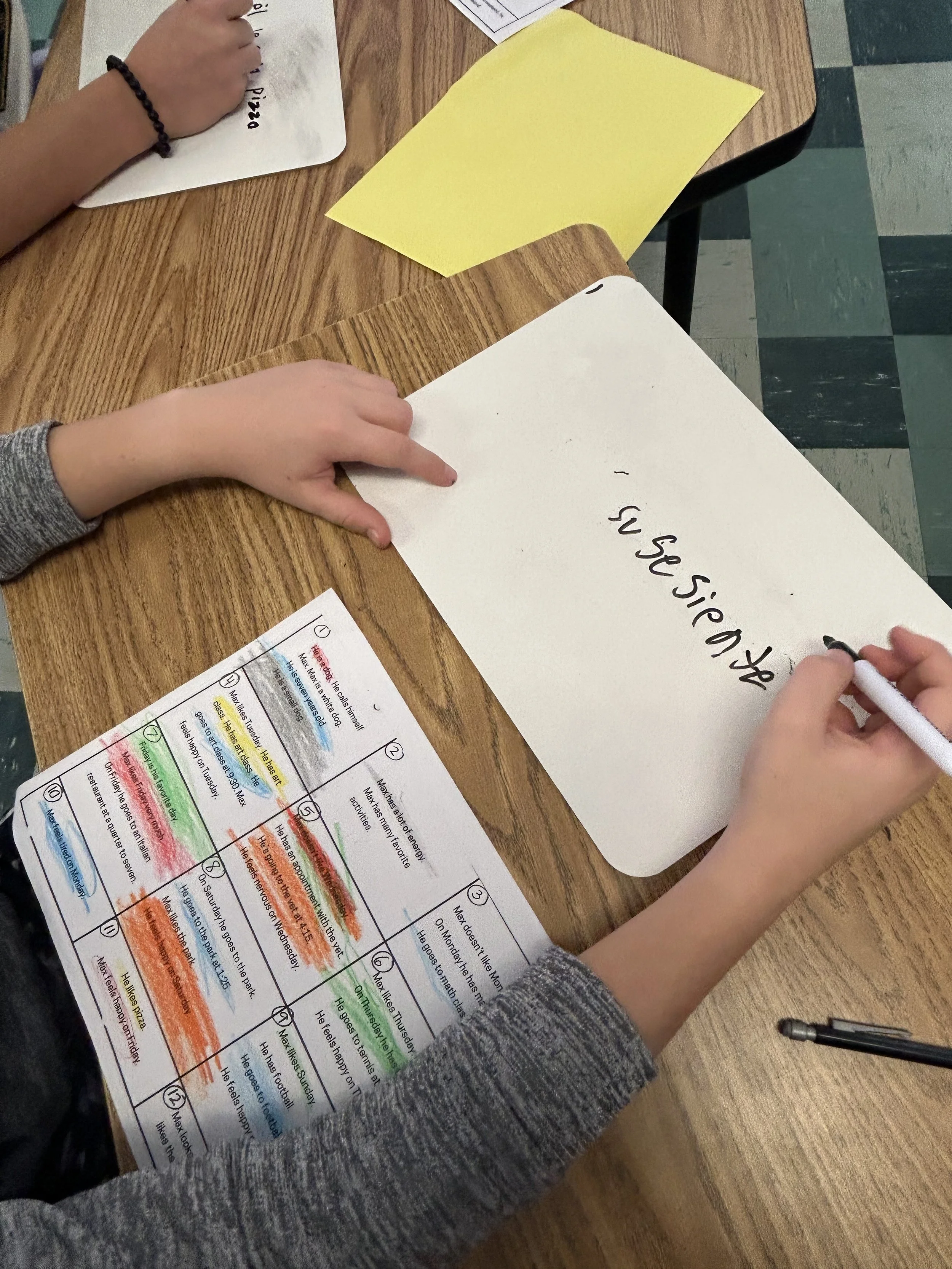
Students can try their best to write the Spanish version, or look for support at the Spanish grid if they need support. Reward points as you think it’s best!
In this round, I’d call out the number of a box and a color. For example, I would say “Dos, Rojo”.
Students had to quickly find the corresponding translation in that box and write it on their whiteboards.
This wasn’t about perfection but about encouraging re-reading and familiarization with the Spanish text.
Scoring:
Keep it positive!!! Every kid should get a point, and let them work in pairs. I never want to raise affective filters when doing an output-based activity.
I vary scoring based on how many days they’ve already spent with a particular story and how familiar they are with it.
If they are new to it, I have them search for it on the Spanish grid and copy it onto their whiteboards. If I’m pretty confident most know it well, I’ll have them wing it and do their best to write the translations.
Typically, students who write the ‘close enough’ translations on their whiteboards earn a point.
Students who get the exact translation earn 2 points.
This rewards everyone and doesn’t discourage kids for not having perfect output at this level.
Key Takeaways: Why This Worked So Well
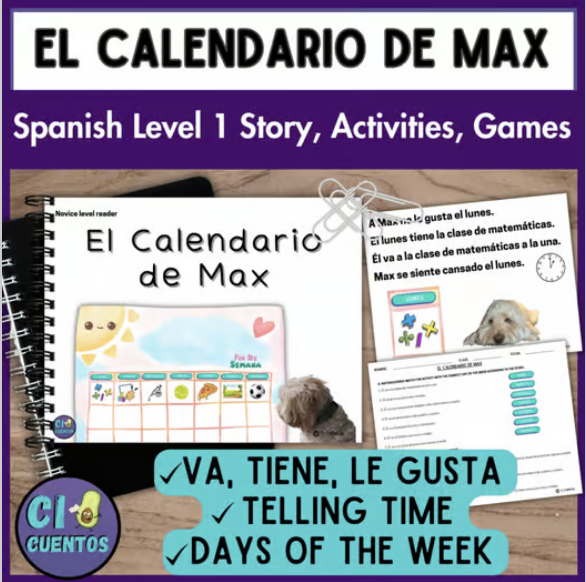
Click to check out the story I mentioned in this post - this game is included in the download!
This activity got students noticing details in a way that just reading wouldn’t achieve. They became more aware of word order, agreement, and even subtle spelling differences.
Even though we reused the same story text, it wasn’t boring. Instead, students felt confident and empowered because they were already familiar with the material. They stayed fully engaged for a solid 45 minutes, motivated by both the game and the familiarity of the story.
By gamifying the translation process, I made learning fun and meaningful, and the students felt like experts in the language. Give it a try—watch your students’ confidence soar as they build language skills in a relaxed, interactive way!
Wishing you less prep and lots of language acquisition this fall!
Catherine
shop here: CI Cuentos Store
Join our Facebook group here: French Toast Cuentos World Language Collaboration